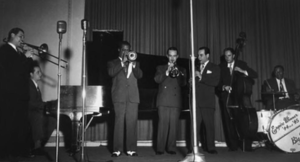
Jack Teagarden with Louis Armstrong & the All-Stars in St. Paul, Minnesota, 1948

Below, a Louis Armstrong Armstrong All Stars Concert from May 8, 1948 in St. Paul, Minnesota. The venue is the St.Paul Auditorium:

The Louis Armstrong All-Stars!

Town Hall Concert May 17, 1947

Town Hall Concert May 17, 1947

It’s generally recognized that a May 17, 1947 Town Hall concert in New York City constitutes the origin story of the Louis Armstrong All Stars touring band. Many fantastic musicians were featured, and Jack Teagarden turned in a classic performance of his version of St. James Infirmary, featuring his trombone-slide-with-waterglass technique:

The official debut of the Louis Armstrong All Stars took place on August 13, 1947 at Billy Berg’s in Hollywood, so the group is a little less than a year old here. Even by that time, however, the All Stars went through a few personel changes, with Earl Hines replacing Dick Cary, and Arvell Shaw replacing the orginal bassist Jack Lesberg. (Morty Corb played bass with the group for a brief time, before Shaw joined in the Fall of 1947.) The rest of the band included Barney Bigard, clarinet, Sid Catlett, on drums*, and of course, Jack Teagarden on trombone. Vocals were covered by Louis, Jack, and Velma Middleton.


Background

The ‘Big Band Era’ was mostly over, and both Louis Armstrong and Jack Teagarden had been leading big-bands in the recent past. Only Teagarden was in a sizable debt as a result, and he’d already begun the “pay it off” journey by leading smaller groups. In May of 1947, Jack was working consistently at the Famous Door in NYC with a quite good band: Peanuts Hucko on clarinet, Max Kaminsky on trumpet and the legendary Sid Catlett on drums.


*After Catlett became ill in April, 1949, his ‘permanent’ replacement was Cozy Cole. May of 1954 would find the All Stars still going with Barret Deems on drums, while Billy Kyle had taken over the piano spot in 1953.

The curator of the Marchant 3M Tape Archiving Project gives this explanation about the origin of this recording, which is one of many he’s shared:

The creator of this archive worked for 3M (who manufactured the Scotch audio tape this was recorded on) in the Twin Cities and likely got special permission to record the concert, as high-quality tape recordings were a novel and still developing technology in the late 1940s. These recordings have sat in various Marchant family homes for nearly 80 years before now being shared with you on YouTube.

The All Stars had been touring widely all year: in February 1948, they received an enthusiastic reception in Nice, France, and just the preceding Monday, May 3, the band played Carnegie Hall.

Here on this recording as elsewhere, Louis’s showmanship sets the tone for the presentation. By the time his All Stars made it to St. Paul, their repertoire was pretty well established, consisting mosty of tunes designed to feature members of the band. Teagarden’s features on the concert consist of 100 Years From Today and Basin Street Blues, but of course his presence is heard throughout. When Louis and Jack perform a vocal duet, as on Rockin’ Chair, the results always seem “just right.” (They’d return to Rockin’ Chair ten years later in Bert Stern’s movie, Jazz on a Summers Day.)

By September of 1951, Teagarden was weary of the All-Stars (nearly literal) all-over-the-world touring schedule, and he decided to leave the group. The trombonist Russ Phillips replaced Jack at the time. His son, Russ Phillips (Jr.) was also destined to become a jazz trombonist! Trummy Young would take over the All-Stars trombone spot about a year after Teagarden left; he’d prove to be every bit the fantastic musical foil for Louis Armstrong that Teagarden was.

Bill Harris: Swinging and Inscrutable

From YouTube, a transfer of Woody Herman’s band performing Bijou for Columbia records. The recording date is August 20, 1945 (coincidentally Jack Teagarden’s birthday). Bijou is a composition by Ralph Burns, who also composed Early Autumn and played piano with the band.

Bill Harris

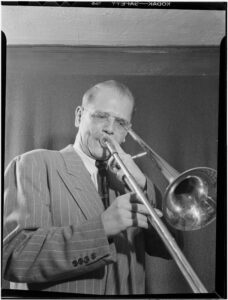
Bill Harris in 1947 (Photo by William P. Gottlieb)

Bill Harris, who was born in Philadelphia on October 28, 1916, takes the trombone solo. His expressive, slightly quirky, style is perfect for the tune, and Harris became associated Bijou after the recording was released. (Check out the Swing and Beyond website for more on Bijou.)

Early on, Harris picked up other instruments, (tenor sax, trumpet), but he didn’t start playing trombone professionally until he was 22 years old. After that, it’s fair to say his improvising style left a big impression.

Unsurprisingly for a trombonist, some of Bill’s first professional work came in big bands: Bob Chester, Ray Mckinley, and Gene Krupa among them. Employment with Benny Goodman came in 1943 and ‘44. (He’d work with Goodman again in the 50s.) According Leonard Feather’s Encyclopedia of Jazz, Bill also led a sextet at the Café Society (Uptown) in New York City in Spring of ‘44. Woody’s orchestra came next, as Bill became a member of Herman’s so-called “First Herd.” He’d hang around for the “Second Herd” also known as the “Four Brothers” band.

It wasn’t all big-band for Harris though. A notable portion of his career involved an association with Norman Granz’s “Jazz at the Philharmonic” (JATP) series of touring jam-sessions. The concerts, begun in 1944 Los Angeles, often combined musicians of varying stylistic bent, which at the time meant swing players and burgeoning beboppers. For his own part, Harris was essentially in the swing camp, but he had no issues fitting in with the “modernists.” From a 1955 “Jazz at the Philharmonic All-Stars” concert in Berlin, here’s Harris blowing up a storm:

In addition to leading small groups himself, Harris also played the sideman role with other small group leaders, including tenor saxophonist Charlie Ventura, and bassist Chubby Jackson, who was also a member of Woody Herman’s first and second herds. With Charlie Ventura’s “Big Four,” below is “Characteristically B. H.” While the melody is be-boppy — maybe even monkish — Harris mostly floats above the rhythm section during his solo:

During the 50s, Harris often performed and recorded with other Woody Herman alum. Here he is playing Everywhere, a ballad of his own composition, with the “Ex-Hermanites”:

Harris spent some time gigging in Las Vegas before eventually retiring to Florida. He died in Hallandale, Florida, at the age of 56, but not before leaving a significant dent in the jazz trombone universe.

More J.J. Johnson at 100

Hello everybody! After J.J. Johnson’s death in 2001, Commander Trombone published the article below:

J.J. Johnson: Thank You Very Kindly

J.J. Johnson: Photo by Chuck Stewart

J.J. Johnson

On the At the Opera House recording J.J. Johnson made with saxophonist Stan Getz, the crowd applauds enthusiastically after J.J. finishes one of his choruses. The trombonist can plainly be heard saying, “Thank you very kindly.” J.J. Johnson, the master jazz trombonist who always accepted appreciation with grace, died on February 4, 2001. His career has been recounted many times, but his remarkable personal qualities are less well known. Despite the fact that musicians and critics consistently heaped praise on him for his expertise with the trombone and his overall musicianship, he remained a humble man his entire life, quick to give others credit and slower to discuss his own accomplishments. But J.J. often revealed something about himself when he talked about peers, colleagues, or leaders he respected. In a 1994 interview conducted by David and Lida Baker, Johnson described Benny Carter, one of his earliest employers and role models, but he could have been describing himself:

He was a brilliant musician, he was a brilliant arranger, a brilliant composer, a nice person to know-he exuded professionalism in his demeanor-when he would talk to an agent or musician or to YOU about your part . . . at rehearsal. He exuded this air of professionalism and dignity and courteousness that was quite extraordinary. He was an extrordinary man, and still is.

The realities of a working musician were something J.J. was familiar with, and Johnson had what he called the “battle scars” gained throughout his career to prove it. His focus, however, remained music: getting it out the end of the trombone or into an arrangement or composition. J.J. will certainly — and understandably — be remembered for having transferred the complexities of be-bop to the trombone with stunning technique, but there was more to it than that. It was musical clarity that J.J. was after. And like Miles Davis (who was a good friend), Johnson understood that a small musical gesture, properly presented, could loom large. As much as anywhere, the connection between the two men’s improvising styles is evident on Walkin’, which J.J. recorded with Miles in 1954. Like Miles, Johnson’s musical world kept expanding, and J.J. believed the music known as jazz should keep expanding, too. In a 1990 interview conducted by Lida Baker for Instrumentalist magazine, J.J. explained it this way:

Jazz is by its very nature is a very restless music. It won’t stay still; it won’t behave. You can’t just put over there and say, “Now be quiet and don’t say anything.” It won’t allow that. It must evolve; it must reach out and explore. When Dizzy and Bird came on the scene there was a hue and cry, “What is this crazy music with flatted fifths called be-bop?” Obviously, it prevailed. I think it will always be like that. When something new comes along there will be resistence to it at first. When Miles Davis recorded Bitches Brew there was a great hue and cry from the critics, the media, from everybody but especially his adoring fans. They raised a big ruckus about it. “He can’t desert us and go off into another world like that,” they said; but that’s what he did.

Johnson’s own musical journey started, in part, with a life-long appreciation of saxophonist Lester Young’s improvising. “I became a Lester Young a-holic,” J.J. remembered. “So much so that I could hum any one of his solos on any one of his recordings verbatim, just from listening over and over and over to a particular cut on a given lp . . . ” From there, J.J.’s musical life kept growing-from innovative and impressive sideman to leader, from arranger of pop tunes to composer of televison and movie scores, from an appreciation of Lester Young, to an appreciation of Hindemith, Stravinsky and Ravel. J.J. wasn’t above listening to “Rock” music either, and purportedly at one time had a fair amount of “Country and Western” in his record collection-but the grounding in jazz remained. As Johnson once put it in a 1970 Downbeat article, “I am a jazzman — first, last, always. But I feel that I must draw on all music to consider myself a complete musician.”

Not a technophobe

J.J.’s musical forays were augmented by interest in many subjects, including electronics. At one point, he assembled hi-fi equipment from a Heath kit. During the period in which J.J. was employed by MBA in New York, he was dispatched to Trumansburg for training on the Moog synthesizer, making him one of the first to understand how the new instrument worked. Johnson became involved with computers and Musical Instrument Digital Interface (MIDI) later, and in his last years spent time composing MIDI compositions for his own amusement which he then archived with the help of a CD burner.

J.J. Johnson in the Internet Age

J.J. Johnson

J.J. Johnson

In 1996, Matt Calvert, a trombonist in the Bay Area of San Francisco, decided to create a web page devoted to J.J. Johnson. Calvert was surprised when J.J. discovered the web site and made contact through e-mail. Soon the two were talking on the phone on a regular basis. Eventually Calvert added a discussion/mailing list to the website in 1998, and musicians from all over the world began to subscribe. The topics discussed on the list ran a gamut from J.J.’s recordings, jazz, other important trombonists, and music in general. When activity on the list was slow, J.J.’s posts proved to be the biggest catalyst in getting things fired up again. His posts, while often about music, could be about nearly anything and were often entertaining. There were occasional controversies on the J.J. mailing list-the real kind and the fake kind provoked by the occasional persistent e-mail exacerbator known on the internet as a “troll.” While heated discourse was never J.J.’s style, he often mentioned on the list that he found the disagreement interesting and provocative. “I’m no goody-two shoes,” Johnson once commented on the mailing list.

A Legacy of Great Recordings

J.J. made hundreds of recordings in his lifetime, some as a leader and some as a sideman. Understandably, he made so recording dates he couldn’t always remember the specific circumstances of each. “I hope the record will show I recorded with Charlie Parker,” J.J. Johnson said in an interview for the Global Music Network. He did, in 1947. He also recorded as a sideman with Sonny Stitt, Sonny Rollins, Dizzy Gillespie, Miles Davis, Horace Silver, among others. His performances as a sideman are always excellent, but on recordings where J.J. is the leader he is able to bring to bear the full level of his ability as a improviser, composer and arranger. The groups involved might be as small as a quartet (First Place recorded for Columbia records), or as large as a big band (The Total J.J. Johnson originally recorded for RCA Victor. The Brass Orchestra recorded for Verve in 1997 is another good example.) Which recordings are the classics? Well, J.J. Inc is excellent. The Eminent J.J. Johnson Vols 1 and 2 are known for their quality. Proof Positive, recorded for Impulse! is a Tour de Force. In truth, though, which J.J. recording is the classic depends on who you ask. One thing is for certain: it is nearly impossible to imagine a bad J.J. Johnson performance. It’s no wonder that he won Downbeat polls for trombone year after year.

Missing in Ken Burn’s Jazz

Johnson was not mentioned at all in Ken Burn’s recent and controversial documentary Jazz. Certainly, J.J was in good company-many important jazz artists were not mentioned either. Yet it still is a shame that a career so full of artistry, mastery, craftmanship, growth and staying power could have gone unmentioned. Some of J.J.’s performances as a jazzman did find their way onto film, kinescope (a film recording of a television picture), and video footage. One of the very best-and most recent-was an amateur video shot in February of 1991 at Kentucky State University, now distributed by Jamey Abersold because Johnson’s performance was so outstanding. (The Global Music Network video link, above left, is another version of the same concert.)

In 1987, J.J. Johnson, not long back into the jazz scene after spending years in California composing for television and movies, played at the Village Vanguard with his newly formed group. The jazz critic Stanely Crouch described J.J. and his triumphal return for the Village Voice:

On opening night, the house was full of enough trombonists to create a brass shortage had the Vangaurd blown up. Slide Hampton presented Johnson with a scroll signed by many fellow trombonists who wished to express their love, respect, and best wishes for the master. It was fitting, and Johnson, who embodies the dash and grace at the center of the feeling of jazz, stood there radiating the aristocratic glow of those who have been chosen by nature to provide flesh and blood examples of poetic excellence. Though there have never been many, few of his kind will always be enough.

Certainly Crouch is right — few of J.J.’s kind will always be enough — but of course what this means is that it will always be more difficult to say goodbye.

100 Years of J.J. Johnson

Yesterday was the 100 year anniversary of J. J. Johnson’s birth, January 22, 1924. Of course, that’s not the kind of day we can just let pass into history without saying something. J.J. was — and is — one of the most influential jazz trombonists ever. A big reason for that influence was a slide-trombone-technical-facility that could meet the demands of “be-bop,” the primarily small band jazz music that emerged after the big band based Swing Era. Given that accomplishment, it seems surprising that J.J. might say the following to jazz critic Leonard Feather about his early experiences with the trombone:

“There’s an innate clumsiness about it; it’s a beastly, horrid instrument to play, and particularly to play jazz on. Many times I wondered, how and why did I ever pick up this horrid instrument?”

How could J.J. feel that way? In The Encyclopedia of Jazz, Leonard Feather wrote of J.J.:

“In the early stages of bop evolution his technique seemed so incredible that many listeners to his records refused to believe that he was not playing a valve trombone to achieve the fast-moving multi-note passages which this type of improvisation sometimes required.”

Even as his innovations were changing people’s minds about what jazz trombone could sound like, J.J. appreciated — and was no doubt influenced by — all the formidable trombonists who could get around all that “innate clumsiness,” thank you very much: Trummy Young, Fred Beckett, Vic Dickenson, Jack Teagarden among others. Importantly, as revolutionary as J.J.’s trombone be-bop forays seemed to be in the 1940s, there was always more to it than mere technical facility. The impetus was musical, and his musical influences began well before the advent of “be-bop.” Johnson became a composer, too. He played and wrote music the way he did because that’s the way he heard it: with clarity. It’s that musical approach, just as much as the technical facility, that remains a model for jazz trombonists today.

Jimmy Knepper Interview

From the National Jazz Archive, an interview with jazz trombonist Jimmy Knepper, who died in 2003. Since high school — after I found the album Jimmy Knepper in LA in the bin at the local Record Bar — his playing has been a favorite.

Jimmy Knepper

Like many jazz musicians of his generation just after the Swing Era, Knepper became fascinated with “Modern Jazz” in general and Charlie Parker’s playing in particular.
At least once, Knepper recorded Parker live himself; he’s responsible for a recording initially distributed by Charles Mingus’s Workshop label called Bird at St. Nicks. (To conserve tape, Knepper turned the tape recorder on only during Charlie Parker’s solos.)

Despite the primary influence of jazz players on instruments other than the trombone, Jimmy’s improvising style is unique and features a personal sound that is immediately identifiable. It’s virtuosic without ever being cold or showy.

Knepper is perhaps best known for playing with Charles Mingus, but he had a varied career which included playing in the Broadway pit orchestra for the entire original run of Funny Girl.