Here, No Time for Talkin’ by the Trombones Unlimited. Also, years ago, the theme for Astronaut Jones on SNL (played by Tracy Morgan).
A quick perusal of YouTube will uncover many Trombones Unlimited albums recorded for Liberty Records. The trombonist and arranger Mike Barone was apparently the leader/instigator for these recordings, which often feature pop tunes and a model on the cover art. All were recorded around 1968. Bob Edmondson, who also played with Herb Alpert, was the original co-trombonist for the first outing, followed by Frank Rosolino for the others. The rhythm section appears to be none other than the Wrecking Crew!
A long time ago, in that great and expansive past history of the slide trombone, at least two things were foretold:
The trombone (sackbut, serpenty-slide, etc.,) will be made into something called a “video game” featuring a trombonist with a giant head. This game will be played even by people who do not play the trombone, and lo, even by people who have no real interest in playing a real trombone. Even further lo, this game shall sound much weirder than a real trombone, with slide accuracy that shall have real trombonists everywhere shaking their heads, not in a good way, even though hitting slide positions is apparently part of the whole point of the game.
Trombonists will, well into the future, get together and talk about which slide oil, lubricant, etc., really works the best (on real trombones).
The first prophecy was always going to be a little tricky, and frankly it seemed like a long shot, but here we are. Welcome to the future! It’s just starting now. The second? Easy. Fulfilled for years. The problem, of course, is that no one will ever be able to really decide which slide lube works the best. Oh sure — people will get close. Here in the technical vastness of the future, many say the best is Yamaha Slide Lubricant, which in the more immediate past was known as Yamaha Slide Oil. Some “swear by” Slide-O-Mix, or “Rapid Comfort.” But when it comes to slide action, will there ever be any real comfort?
Almost any English teacher can be counted on to make some sort of a handout on when to use a comma. It’s sort of that same way with brass players and exercise books, going back — at least — to Arbans famous method.
Both comma handouts and brass exercise books have this in common: despite some points of controversy, you end up with lots of similar material and advice. And yet, despite all that, there’s still the occasional insight and innovation.
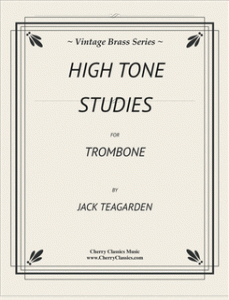
In 1936, Jack Teagarden, the jazz trombonist from Vernon, Texas, known for his ability to play a whole lot of trombone in the first 4 positions, came out with his High Tone Studies for Trombone, a short treatise of 51 exercises designed to help get the player up to a high D. The book is currently available on Apple’s iBooks, and also at Cherry Classics Music. As CCM’s blurb says, “it is obvious that Teagarden had put a lot of thought into his technique.” A bit of classic good advice from the book:
Do not force or strain at any time. Rest frequently.
It’s the birthday of one of the great voices of jazz music, J.J. Johnson. Of the slide instrument, J.J. — often referred to as the father of modern jazz trombone — once quipped, “It’s a horrible, beastly to play, especially to play jazz on.” Well? You could never really tell that when J.J. played. His handling of the trombone always projected a relaxed calm, and the musical results speak for themselves.
In 1960, for Jazz at the Philharmonic, here’s J.J. playing with Stan Getz and band: Victor Feldman piano, Sam Jones, bass, Louis Hayes, drums. The location is the Salle Pleyel in Paris, France. The musical vehicle is Sweet Georgia Brown, a tune whose changes J.J. was evidently fond of improvising on. He recorded it more than once as a harmonic basis for tunes he composed like Sweet Georgia Gillespie and Tea Pot. Speaking of composing, the fact that J.J. was an inventive composer showed in all of his musical expressions.
A while back, I wrote about Larry McCabe’s EP, Irish American. I am pleased to say it’s now a full length album, and it is — as we say in the trades — completely bad-ass. As I write this, I’m quite certain that Larry would say that this recording project — in addition to being an education — has been a labor of love. (Of course, all recording projects are an education when the artist is truly involved, but I’m digressing.) To the point, love shows in the music, which ranges from hard rocking — O’Diddley, for example — to dance-worthy, to serene and beautiful. A little excerpt of what Larry says about it:
I was born in the heartland of America. My great great grandfather came here from Ireland. I grew up listening to all kinds of music and was fortunate enough to play with some very talented and soulful musicians right out of high school. It was a time when you could go on the road, play music and make a living. I played with everyone from Brenda Lee to Maynard Ferguson and had a ball. A few years back I started listening to Irish music and it it literally struck a chord with my ancestral roots. I love pure traditional music.
Over the years, and no doubt through the musical experiences he mentions above, Larry’s been able to match his musical sensibilities to the slide instrument, with the result that today his musicality and trombone playing are easily in a class by themselves.
One of my personal favorites from Irish American is a marvelous, arranged-on-the-fly, trombone choir: Annie McMahon. Clan McCabe is nothing short of a trombone power ballad. (The euphonium is used here to great effect, too.) Is some of this music shades of Trombone Shorty? You bet! So, check out Larry McCabe’s Irish American — as in right now!
Cookie Consent
We use cookies to improve your experience on our site. By using our site, you consent to cookies.