The Obvious Love for Slide Hampton

Some heartfelt tributes for Slide Hampton have rolled in this month. First, a video presentation from trombonist Dion Tucker at his YouTube channel. He shares his great photos and insight:

At JazzTimes, here are Michael Dease’s reflections on Slide Hampton.

Related: Michael Medrick’s collection of transcribed Slide Hampton solos, mostly from the excellent Mad About Tadd recording.

Trump Broke Democracy

One of the rationales many people had for electing Donald Trump as POTUS was that he was a “disrupter” who would “shake up the system.” Mission accomplished; the presidency of Donald Trump has been a wild ride. Or, more accurately, a broken ride at a more-or-less abandoned theme park out on the edge of town. The park is apparently open, but the rides aren’t really staffed and the safety bars can’t be lowered.

Unfortunately, shaking up a system is far too easy when you don’t understand how it’s supposed to work. Once, people might bang on the side of their TV sets if the picture got wobbly. You don’t see that anymore. This, however, is figuratively the “troubleshooting” technique of Donald J. Trump: just break things further. Added to this is
Trump’s unshakable belief that other people, laws, rules, (or norms of any kind), only exist to benefit him personally. The rest is window dressing. Fortunately for Donald Trump, there’s a whole political party dedicated to window dressing.

No more. Donald Trump must go.

High Flight

Back when I was in high school in the late 70s, television stations actually ended broadcast for the day. What often directly preceded the impending
TV “snow” was the poem heard in the video below, High Flight, by aviator John Gillespie. The short film depicted an airplane doing all kinds of tricky maneuvers as the poem’s words were intoned. Yeah. If you were going to “Slip the Surly Bonds of Earth,” this was how you did it, in a shiny, American, cold-war airplane. It’s still unclear to me what any of it had to do with signing off, but what it actually meant was, “Look — the broadcast day is over. This station has done all it can for you today. No more Petticoat Junction reruns. Nothing more to see here until 6 am. Get some sleep. Goodnight.”

Etude Magazine, April 1955: Two Centuries of Trombones

bobjones

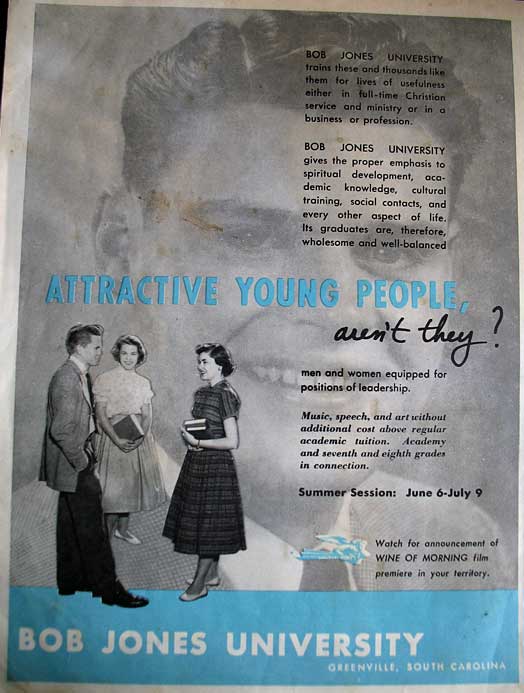
No posts since December? Er, Happy New Year? To get things rolling again, a trombone article from the April, 1955 issue of ETUDE magazine is discussed below. The history of The ETUDE magazine is recounted here. This particular issue featured the ad pictured in the inset on the back. Click for a larger version.

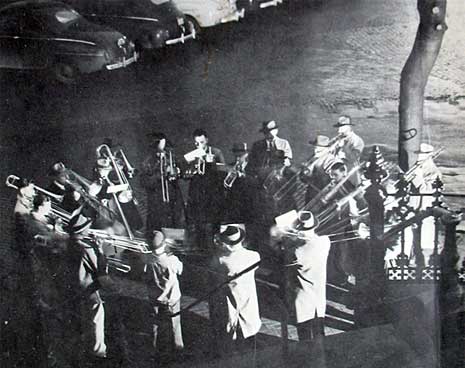
The April, 1955 issue of ETUDE music magazine featured the article, “Two Centuries of Trombones.” The title was a little deceptive: instead of covering everything about trombones over the course of two centuries, the piece focussed on how trombone playing was historically significant to the town of Bethlehem, PA. Specifically, the town trombone choir’s performances were used to mark events that were solemn, lighthearted, or . . . anything. Below are excerpts from this article that frustrated readers of this website — yearning for new content — may find edifying:

Etude Magazine

“Why trombones? It has been suggested that the somber tones of these slide instruments were in keeping with the idea of playing chorales to announce a death as well as providing music at a funeral. Add to that an all-weather instrument for outdoor playing (although the slides of the trombone will freeze in very severe winter cold), and you have a practical as well as an aesthetic reason for the use of the trombones.”

Remember, though, these trombonists were not buskers. In fact, in stark contrast to buskers, the trombonists could be mobilized immediately as defenders of the town, particularly around Christmastime.

Bethlehem trombonists focus sound energy safely inward

Bethlehem trombonists focus sound energy safely inward

“A legend has grown up around the Christmas tromboning of that year [1755]. The story has long been accepted by many people that late Christmas Eve a war party of Indians camped across team Monacacy Creek, planning to attack the settlement as the sun rose. However, the trombonists from their rooftop position greeted the day before the Indians. The redmen, hearing sounds they could not understand, thought that it was the voice of the Great Spirit telling them to leave Bethlehem in peace.”

It’s likely that some sort of qualifier was needed there, like “may have thought it was the voice of the Great Spirit.” Or, a complete revision: “The native americans, hearing sounds they quickly identified as trombones, felt a little sorry for the pale-skins and decided that any sort of attack was simply not worth it.” Anyway, back to Christmas:

“Of course, at Christmas the trombone is not neglected. The Christmas eve love feast is opened with the playing of Hail Thou Wondrous Infant Stranger, and later the vigil services begin with the notes of Hark a Voice from Yonder Manger. These are old chorales. Either one or both may have been used in 1755. At that time it was the custom for the trombonists to announce Christmas day at dawn.”

etudeapr55trb2

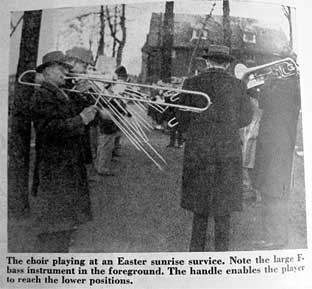
The majestic sounds of the trombone are both festive and appropriate for Christmastime, and likely met with the approval of the townsfolk (provided the intonation was halfway decent). The possible downside? It seems the musical encouragement meant the trombonists were always up and playing at the crack of dawn regardless of the time of year or holiday. Easter is next, and naturally that involves waking everybody up, too. But how? With a large F-Bass trombone with a handle that allows the player to reach the longer slide positions.

“Long before the congregation assembles in the church, from whence they proceed to the cemetery, trombonists pass through the community awakening the sleepers with the chorales announcing that The Lord has risen.”

By the time 4th of July rolled around, the town had the good sense to put the kibosh on the “up-early and always playing the trombone” thing:

“In the past it was even customary to herald the Fourth of July at daybreak, but this custom has been given up, either because folk living near the church liked to sleep on a holiday morning and objected to being disturbed at sunrise, or the trombonists themselves preferred Morpheus to Polyhymnia.”

Importantly, there can be no ETUDE trombone article without a funny little anecdote that involves the total disruption of a beleaguered trombonist’s embouchure. Here goes nothing:

“Stories are still told of how one player’s false teeth fell from the steeple to be shattered on the roof of Simon Rau’s drug store far below, but there is no record of a trombone ever having fallen to the same doom, although from time to time someone’s hat becomes a casualty.”

To conclude this ETUDE article, there’s a quote from Rufus A. Greider, who, 80 years previous to 1955, had written about the unwavering dedication of the Bethlehem trombonists.

“It requires not a little self-denial to serve as a performer of the trombone choir. He is required to attend all services when they are used. He is obliged to assist in announcing every death which occurs in the congregation, to play at the funerals, to play on every festival, morning and afternoon, to perform before the celebration of the Lord’s supper. He is duty-bound to go to the graveyard or climb in the church belfry at all seasons and in every kind of weather; cold or rain must not be heeded, he goes through it all.”

In other words, these guys should have unionized.

Next:

“THE END”

That’s one way you know an ETUDE article is over. There’s a big “THE END” at the article’s conclusion.

THE END

The Pride of the Southland

A Marching Band Memory

Picture of 1982 World's Fair serving Tray

Yeah…well…you had to be there

In the Fall of 1981, I was a freshman at the University of Tennessee at Knoxville. It was an interesting time to be there, with the 1982 World’s Fair just about to break out in the city. Just look at the commemorative serving tray, pictured here. Yes, the future seemed within our collective grasp.

Anyway, fortunately for me, I had a band scholarship. Perhaps somewhat unfortunately, as a condition of that scholarship I was obliged to play in the University of Tennessee Pride of the Southland Marching Band.

There must have been some aspect of marching that I enjoyed, and maybe I thought that membership in the marching band provided a kind of continuity from high school. In retrospect especially, this notion is crazy. As a naive freshman, I was simply not prepared for the gargantuan priority shift that was occurring all around me. Inebriating liquids would play a huge role. On campus, the Pride of the Southland Marching Band was no exception to this college drinking trend, and probably was its true standard-bearer.

The marching style, too, was very different from what I was used to. In contrast to the wannabe-drum-and-bugle-corps style of high school, the “Pride of the Southland” style of marching was a military style, involving circles, diamonds and straight lines up and down the field. While the pre-game show — featuring Rocky Top — was relatively fixed in execution, each half-time show was freshly envisioned for each game. To accomplish these new marching drills, each band member was issued a printed chart telling him or her where and when to move. Negotiating the formations could be tricky.

Many of the marching drills were charted by the long-suffering assistant band director, Walter McDaniel. During rehearsals on the field, McDaniel did his best to be civil, but not surprisingly, the half-crazed-college-kid-marchers could drive him to a level of exasperation that would be difficult for any sane man to handle. On one occasion, in a conflicted fit he famously uttered, “Damn it…Please…Damn it…Please…” It became a band catchphrase.

Then there was the band’s leader, Dr. W.J. Julian, who was simultaneously reviled and loved by those in the band. Although Dr. Julian, then the president of the American Bandmaster’s Association, had his genteel moments in which he spoke about sipping cognac by the fire, he was on the other hand a man who truly understood what it meant to be hell-bent. Undoubtedly, part of the reason for W.J’s disposition was something that happened many years earlier: three years to the day after the attack on Pearl Harbor, the ship he was on as a young man — LSM318 — was sunk by a Kamikaze pilot in the Philippines.

During parts of a show, Julian would conduct atop a ladder on the sidelines. His conducting style was deliberate and jerky, and often seemed to be an expression of his own frustrations with trying to get the band to perform as he wanted. During show run-throughs, he’d take to the field, run through the formations, and deliver in-face, generally non-positive reviews of how you were doing. These displays were almost always issued with the true histrionic furor common to tyrants and some who try to motivate those in post-secondary education. A favorite gesture was one in which Dr. Julian, his angry, beet-red face already apparent, would rip off his sunglasses, revealing furious eyes. After a dramatic pause, there would come the smack-down utterance, the coup de gras. Once, when I made a misstep during rehearsal, Julian got up in my face, performed the glasses rip, and quietly growled in my ear, “You don’t know shit about this show.”

After rehearsals on field, the whole band would get their notes on how we did. Dr. Julian would ascend his ladder, Douglas-MacArthur-like. We’d all gather around. He’d look out at the horizon, the sun gleaming off of his aviator sunglasses. Eventually, he’d say, “That was better, but it was still horrible.” Expanding a bit further, he’d say, “Some of you…” — his voice would trail off, then — “MOST OF YOU! — are INSOLENT and COMPLACENT!”

On one occasion, the band was handed a reprieve from learning a new and complicated halftime show: a tribute to the United Way. The band would forego its usual repertoire of constantly moving circles and diamonds. Instead, we’d simply form the United Way symbol, face the press box, and play a touching song meant to pull at the heartstrings of the assembled fans.

When halftime arrived, everything seemed to go well. On a crisp and clear Fall day, the Pride of the Southland Marching Band formed the United Way symbol in the middle of the field. We were almost ready to play “You’ll Never Walk Alone.” First, though, the sound of the announcer’s voice boomed through the PA and slapped around the stadium in that bigger-than-life-college-football way:

“Ladies and Gentlemen!…The United Way!…Thanks to you it’s working!…Listen as the University of Tennessee Pride of the Southland band plays…You’ll Never Walk Again.”